
The Unknown Story of a Billionaire Trader
How Jesse Livermore made $100 Million & Lost Everything


Source: neofeed.com.br
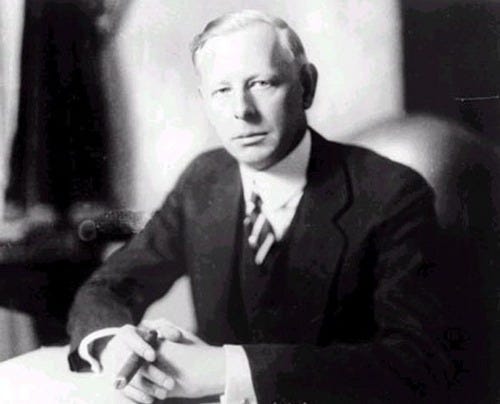
Jesse Livermore is regarded as one of the greatest traders ever.
More recently, some of his quotes have become popular on social media like Telegram. He’s probably the most quoted trader of all time.
Unlike many other investing greats, Jesse isn’t alive today. He was active around 100 years ago. He was born in the eastern USA state of Massachusetts. At age 14, he fled home.
At such a young age, he got himself a job in Boston as a board boy - someone who posts stock quotes at stock brokerages (no computer screens back then).
Being a fast learner, he caught on quickly.
When in that ecosystem, his interest grew in bucket shops. Bucket shops weren’t places to buy or sell stocks but were places to bet on their movements.
At the age of 15, he bet on a railroad company. He earned $3.12 on that in 2 days (his salary was $6 at that time).
By age 16, he had quit his job and was a full-time trader. Also, most bucket shops had banned him - he was that good.
In about 3 years, he had been able to generate a return of 1000%.
He tried trading under fake identities but was soon discovered because of his consistent wins. Jesse called himself a speculator, not a trader. He used techniques that are now known as technical analysis.
He was a trend follower - a perfect one at that.
Jesse stuck to stocks that were moving in a trend - never stuck in a range.
He never invested based on what he felt. He waited for some movement in the markets to confirm what he was feeling before taking action.
He always used a stop loss.
Sector-leading stocks were his trading picks in a bull market. Weak stocks were his favourite in bear markets. And he never followed too many stocks - that was too much information to process.
In 1900, he moved from Boston to New York - a new city, a new start.
In a matter of 5 days, he converted $10,000 into $50,000. As a trader, he used leverage very liberally. Young, rich, bold, and confident, Jesse was on a roll.
In 1901, when he was only 24 years old, he anticipated a deep correction and shorted using a 400% leverage. He’d put in most of whatever money he had.
There was some delay in updating the board and it affected Jesse’s decision-making.
He lost everything.
He borrowed $2000 and left the city for another city, St Louis, where nobody knew him. There, he started going to bucket shops again. Hurt from losing it all, Jesse wanted to climb back. He did, very fast.
In 1901, he turned $10,000 into $500,000 speculating in another railway stock.
What followed after that was a string of successful bets.
He attributed much of his success to sitting and waiting - something other speculators found difficult to do. He grew rich and reached the highest of the echelons of society. He bought a yacht, a railcar, and homes.
In 1908, he met Teddy Price who persuaded him to invest in cotton.
One of Jesse’s now-famous beliefs was that of keeping profit makers and selling loss-makers. Oddly enough, while Jesse preached this, he struggled to stick to this.
All this while, Teddy was slyly selling cotton and Jesse kept buying the loss-making commodity.
Jesse lost all he bet.
Jesse hated tips. He believed that a man must trust his judgment. And yet, with cotton, he allowed himself to speculate using Teddy’s suggestions.
He managed to bounce back - as he always had done. Every time he hit rock bottom, he spent time understanding what had gone wrong. Those mistakes, he avoided making again.
Jesse declared bankruptcy in 1915.
Jesse has many feathers in his hat - some he’s admired for, some he is infamous for.
He was accused of manipulating the market in 1924. He even had the market cornered to the point where the president of the USA called him and asked him to stop.
In 1929, when the Great Depression set in, he shorted at the right time and made over $100 million!
When the entire country was reeling under economic crisis, this man-made $100 million (equivalent to about $1.5 billion in today’s time).
In 1934, SEC was formed (like we have SEBI). With SEC and its new regulations, Jesse’s trading became tough.
Then, he made a few wrong bets. When the markets were low, he bet against them but the markets climbed. When they reached a certain high, he bet for them and the market went down.
He lost everything. In 1934, he filed for bankruptcy again. He managed to settle his tax dues a few years later and started consulting.
Jesse once reflected that surviving was the most important rule. He said that it was because he knew he’d make it back that he took such great risks.
In 1939, he made another shot at a comeback.
In 1940, he wrote a message addressed to his then-wife informing that he was tired and couldn’t fight any longer among other more personal things.
After writing that, he shot himself dead.
Jesse Livermore was incredibly smart and wise.
But speculation is just such a space, intelligence can only carry a person so far. Eventually, a lot depends on fate.
What is necessary is something Jesse preached but like his other beliefs, failed to follow all the time - surviving is the most important.
Thank you for reading, see you in the next one.
-Aryan
Further:
Reminiscences of a Stock Operator - Edwin Lefevre
Big Mistakes - Michael Batnick
Extraordinary Delusions and the Madness of Crowds - Charles Mackay